



By Tayo Mabeweje
For decades, the Ibadan–Ijebu-Ode Road existed as more than a neglected federal highway. It became a symbol of postponed development, lost economic opportunities and the frustration of communities whose aspirations were repeatedly held hostage by a road that had long outlived its usefulness.
Today, that narrative is changing.
The flag-off of the reconstruction and dualisation of the 58-kilometre Ibadan–Ijebu-Ode Road by President Bola Ahmed Tinubu is not merely another infrastructure ceremony. It is a powerful declaration that the era of abandoned strategic corridors is giving way to an era of renewed connectivity, economic expansion and purposeful federal intervention.
And for Ogun State, particularly Ogun East, the significance is enormous.
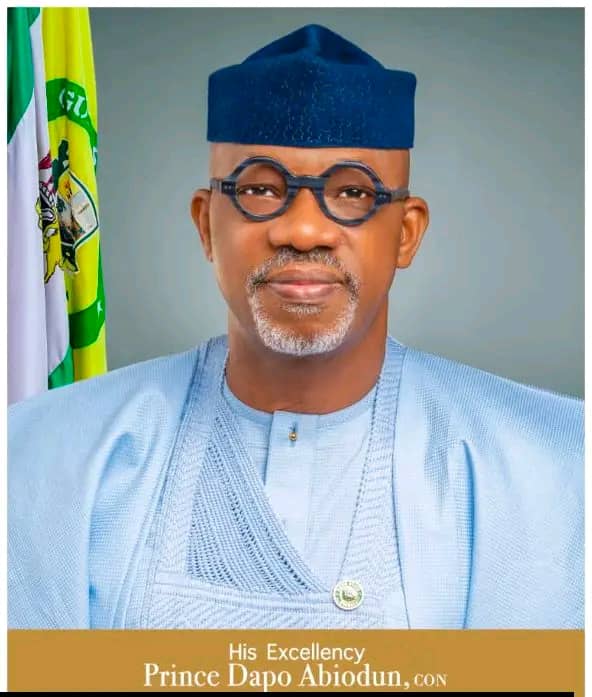
Represented at the flag-off ceremony in Ibadan by Ogun State Governor, Prince Dapo Abiodun, President Tinubu has demonstrated once again that the Renewed Hope Agenda is not simply a political slogan but a development philosophy increasingly finding expression in concrete projects across Nigeria.
As the saying goes, “The road to prosperity is never built on promises; it is paved with purposeful action.”
The Ibadan–Ijebu-Ode corridor is one of those strategic arteries capable of changing the economic geography of an entire region. Connecting Ibadan, Ijebu-Ode and the wider Lagos–Ogun economic axis, the road opens a vital gateway for agriculture, commerce, manufacturing, education, tourism and human mobility.
Its reconstruction with continuous reinforced concrete pavement is therefore not just about asphalt, concrete and engineering. It is about rebuilding possibilities.
It is about a farmer moving produce to market faster.
It is about manufacturers moving raw materials and finished products with less difficulty.
It is about students reaching educational institutions safely.
It is about businesses reducing logistics costs.
It is about families spending less time trapped on dangerous and dilapidated roads.
Most importantly, it is about restoring confidence in communities that have waited patiently for government to act.
President Tinubu deserves commendation for taking decisive action on a road that has remained a major infrastructure concern for years. His administration has recognised that economic transformation cannot occur without functional transportation infrastructure.
The President’s approval of the immediate reconstruction and dualisation of the 70-kilometre Abeokuta–Ibadan Road further elevates the significance of the development.
Taken together, the Ibadan–Ijebu-Ode and Abeokuta–Ibadan projects represent a potentially transformative transportation network for Ogun and Oyo states, strengthening the economic web connecting communities, industries, markets and major urban centres.
For Ogun State, this is particularly significant.
For years, many critical roads passing through the Gateway State have suffered neglect, deterioration and inadequate federal attention. Today, however, the picture is gradually changing.
From the Lagos–Ibadan corridor to the Lagos–Calabar Coastal Highway and now the Ibadan–Ijebu-Ode axis, federal infrastructure intervention is increasingly positioning Ogun as a critical engine of regional economic growth.
This is where the leadership of Governor Dapo Abiodun deserves particular recognition.
Governor Abiodun has consistently projected Ogun State as an investment destination and has pursued strategic partnerships with the Federal Government to unlock the state’s enormous economic potential.
His administration’s development philosophy has been built around infrastructure, industrialisation, investment attraction and connectivity. The renewed attention to federal roads across the state therefore complements a broader vision of transforming Ogun from merely a gateway state into a national economic powerhouse.
When neglected roads receive attention, forgotten communities receive visibility; when strategic corridors are rebuilt, entire economies begin to breathe again.
The Ibadan–Ijebu-Ode Road could consequently become one of the most consequential infrastructure interventions for Ogun East in recent years.
For the people of Ijebu North, Ijebu East, Ogun Waterside, Ijebu-Ode and adjoining communities, the project carries enormous economic implications. It can unlock farmlands, stimulate commercial activities, improve access to markets and strengthen the relationship between communities on both sides of the corridor.
The road’s reconstruction is also a powerful response to the security challenges that have emerged along poorly maintained transportation routes.
As the Olubadan of Ibadan, Oba Rashid Ladoja, observed, the deplorable condition of the road had contributed to security vulnerabilities along the corridor. Improved accessibility, regular movement and increased legitimate economic activity can help reclaim spaces that criminal elements may otherwise exploit.
The intervention, therefore, is simultaneously economic, social and security-oriented.
It is also significant that the Federal Government has set a completion target of June 10, 2029, while the contractor has assured that construction will be completed in less than 24 months. Such commitments must be matched by rigorous supervision, community cooperation and unwavering political will.
The people must also play their part.
Host communities must protect the project, discourage encroachment and resist actions capable of frustrating construction. Infrastructure belongs ultimately to the people, and protecting it is a collective responsibility.
The Minister of Works, Engr. Dave Umahi, deserves commendation for the renewed focus on major road infrastructure across the South-West. His disclosure that the Federal Government has commenced procurement for the Abeokuta–Ibadan dualisation further reinforces the scale of the intervention.
The bigger picture is compelling.
Ogun is becoming a convergence point for some of Nigeria’s most important economic infrastructure projects. The Gateway International Airport, industrial corridors, emerging seaport-related developments, the Lagos–Calabar Coastal Highway and the renewed attention to critical federal roads are creating a network of opportunities capable of redefining the state’s economic future.
And within that emerging future, Ogun East stands at a particularly strategic crossroads.
This is why the conversation about Governor Dapo Abiodun’s political future cannot be divorced from the larger question of how Ogun East can maximise its influence at the national level.
If the people of Ogun East eventually elect Governor Abiodun to the Senate in 2027, his experience at the state level, familiarity with the Federal Government and understanding of Ogun’s development priorities could provide the district with an experienced advocate at the national policy table.
A senator who understands the road from the village to the capital understands the language of development differently.
Abiodun’s potential transition from the Governor’s Lodge to the National Assembly could therefore represent an opportunity for Ogun East to strengthen its voice on federal infrastructure, economic development, industrialisation, security, agriculture and strategic national projects.
The argument is not merely about political succession. It is about continuity of development advocacy.
Ogun East requires a voice capable of translating local aspirations into national priorities, and capable of engaging effectively with federal institutions to attract projects, investments and opportunities.
The Ibadan–Ijebu-Ode Road has shown what becomes possible when state and federal interests converge around a common development objective.
President Tinubu has provided the federal political will.
Governor Dapo Abiodun has continued to champion Ogun’s strategic interests.
The people now have a responsibility to protect the opportunity.
History will judge this generation not by how many roads it complained about, but by how many roads it helped build, protect and transform into pathways of prosperity.
The Ibadan–Ijebu-Ode Road is therefore more than a road.
It is a bridge between yesterday’s neglect and tomorrow’s possibilities.
It is a corridor of commerce.
A pathway to investment.
A catalyst for rural development.
A potential shield against insecurity.
And, above all, a physical manifestation of what purposeful leadership can achieve when political will meets developmental vision.
President Bola Ahmed Tinubu deserves applause for moving this long-awaited project from the realm of expectation into execution.
Governor Dapo Abiodun deserves recognition for his persistent commitment to positioning Ogun State at the centre of Nigeria’s economic renaissance.
And Ogun East stands before a new horizon.
If the Gateway State is truly entering an era in which neglected roads are being reclaimed, economic corridors are being rebuilt and federal attention is returning to communities long yearning for development, then the political choices of 2027 will carry consequences far beyond the ballot box.
The road is being rebuilt today; the economic future of Ogun East can be rebuilt tomorrow.
The signs are unmistakable: Ogun East is on the threshold of a new dawn under the strategic leadership and vision of Prince Dapo Abiodun.
Tayo Mabeweje is a Senior Special Assistant on Media to Governor Dapo Abiodun CON








Leave a comment